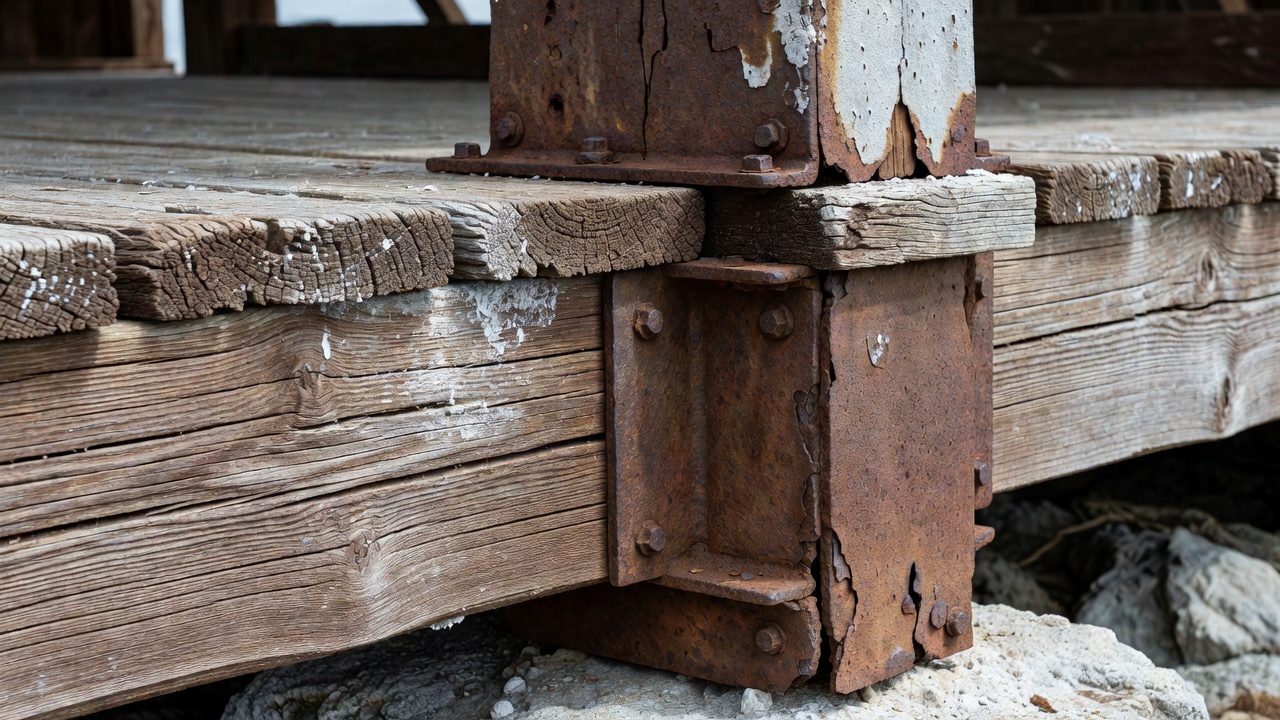
Describe the exposure before the product
“Coastal” is not a single material exposure category. Distance from breaking waves, prevailing wind, shelter, rainfall and local geometry all influence salt deposition and drying. A surface under a deep roof may receive little natural washing while still collecting airborne salts. A nearby exposed face may experience more rain but also stronger ultraviolet radiation and repeated wetting.
Document the microclimate of important components. A roof sheet, a deck fixing and a column base may need different specifications even within the same pavilion. Ask how each part becomes wet, how it dries, how it is cleaned and what happens if the intended coating is scratched. Product literature should be checked against the actual application rather than used as a substitute for exposure assessment.
ISO 9223 provides a framework for classifying atmospheric corrosivity, while ISO 12944 addresses protective paint systems for steel structures within its scope. Their existence does not establish a site category automatically. Interpretation, current requirements and the chosen system belong with competent designers and suppliers familiar with local conditions.
Let timber weather without hiding decay
Timber can suit coastal shelters because components can be relatively light, readily shaped and individually replaceable. Its performance still depends on species, grading, treatment where needed, detailing and maintenance. Responsible sourcing is a separate question from durability: certification through organizations such as the Forest Stewardship Council or the Programme for the Endorsement of Forest Certification does not itself establish suitability for a wet structural application.
Surface graying is not the same as structural decay. Ultraviolet exposure and weather can change color while trapped moisture creates a different and potentially serious problem. Give end grain particular attention, avoid pockets that retain water and separate timber from persistently wet ground where the structural design permits. Deck spacing and fastening should accommodate the selected product’s movement and installation guidance.
Do not specify a pale finish merely to preserve a first-day appearance unless the owner understands the renewal work. A realistic material palette anticipates uneven exposure, repair patches and replacement boards. Check splintering, slip behavior and touch surfaces as practical safety issues rather than treating weathering only as an aesthetic.
Treat metals and concrete as systems
Stainless steel is not immune to corrosion. Alloy selection, surface finish, crevices, contamination and local exposure influence performance. A label such as “marine grade” is too broad to settle a specification. Galvanized and coated carbon steel also need appropriate detailing and maintenance; cut edges, damaged coatings and inaccessible interfaces deserve attention during design and installation.
Where dissimilar metals meet in the presence of an electrolyte, galvanic corrosion can become a concern. Isolation methods must suit the assembly and remain effective over time. Consider fasteners, washers, runoff paths and concealed backing pieces, not only the two largest visible elements. Any isolation detail must also satisfy structural, fire and other applicable requirements.
Reinforced concrete presents another set of decisions. Chloride ingress can contribute to reinforcement corrosion, so exposure classification, concrete quality, cover, crack control and workmanship matter. EN 206 and ACI 318 offer relevant frameworks in their respective settings. Neither a massive appearance nor a smooth finish proves durability. Specify inspection and repair access where vulnerable joints or embedded items could become hidden problems.
Compare maintenance, not just purchase
A fair comparison considers the whole assembly over a stated service period. Include coating renewal, replacement frequency, access equipment, transport and end-of-life options. Environmental product declarations can improve transparency, but comparisons need compatible assumptions and boundaries. A lower initial impact is not necessarily a lower lifetime impact if premature replacement is likely.
Design a maintenance sequence that someone can actually carry out. Show how a board is removed, how the back of a bracket is inspected and where runoff goes during cleaning. Avoid specifying washing routines that cannot be performed without damaging nearby habitats or sending unsuitable residues toward the sea. Maintenance instructions should distinguish routine observation from work requiring a qualified contractor.
Before handover, record product names, grades, coating systems and replacement requirements. Photographs of concealed connections can support later inspections, though they do not replace physical access. A short, accurate component register is more valuable than a vague promise of low maintenance. The aim is not a pavilion that never changes, but one whose changes remain understandable and manageable.