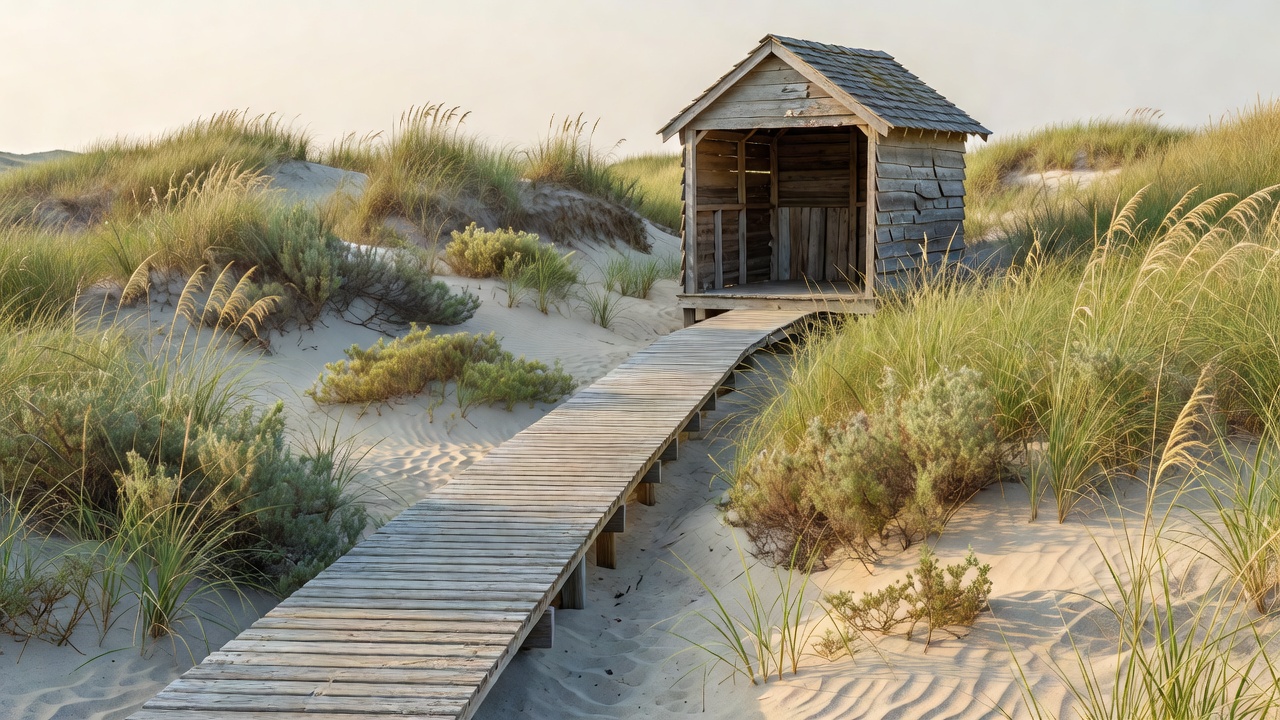
Ask whether this is the right place
A beachfront is a dynamic system, not a vacant strip waiting for an architectural object. Dunes exchange sand with the beach, vegetation stabilizes some surfaces and storms can reorganize familiar ground. Before drawing a roof, establish land ownership, public access rights, habitat sensitivities, heritage interests and the local planning framework. Consultation should include relevant authorities and affected communities, including Indigenous or traditional custodians where applicable.
Compare options rather than assuming construction at the water’s edge is necessary. An existing disturbed site, a shared facility farther inland or a smaller intervention may meet the same need. Avoid presenting a raised deck as inherently harmless: piles, installation access, shade and visitor pressure can still affect habitat and sediment processes.
Assess coastal hazards with qualified local advice. Erosion, inundation, wave action and scour have different implications, and a historical shoreline is not a guaranteed future boundary. Resources from the U.S. Geological Survey and NOAA illustrate coastal processes, while the IPCC provides broader climate context. None of these replaces a site-specific assessment or the applicable planning decision.
Protect the landscape during use
Construction disturbance is only the beginning of the ecological story. A new shelter can attract repeated foot traffic, informal paths, litter and vehicle movements. Plan the approach as carefully as the destination. A clear, accessible route can concentrate movement, but its alignment and construction method should be informed by local ecology rather than convenience alone.
Dune vegetation is not simply ornamental planting. Species, root systems and habitat relationships vary by coast. Replanting with an attractive but unsuitable species can create new problems. Use locally appropriate ecological advice, protect retained vegetation during construction and determine how damaged areas will be monitored. Seasonal nesting or breeding activity may constrain both building work and ordinary visitor access.
Lighting also deserves restraint. Ask whether night lighting is necessary before selecting fittings. Where it is required, consider timing, shielding, intensity and ecological effects with a specialist. Coastal wildlife, including nesting sea turtles in some regions, can be affected by inappropriate light. DarkSky International and local wildlife agencies offer useful background, but local species requirements must guide the actual design.
Follow water and material flows
A small roof concentrates rain that previously fell across a wider patch of ground. Directing it to a single edge can cause erosion, undermine a path or disturb planting. Coordinate drainage with soil conditions, groundwater, contamination risks and local requirements. Infiltration is not automatically suitable everywhere, and collection systems need a maintenance plan as well as an intended use.
Material decisions should account for the complete assembly. A lightweight roof may require additional framing; a durable finish may involve repeated treatments; a seemingly reusable component may be bonded to something difficult to separate. Whole-life assessment makes these relationships visible. ISO 14040 and ISO 14044 describe life-cycle assessment principles and requirements, while EN 15978 addresses building-level environmental performance assessment.
Use environmental product declarations carefully. Products cannot be fairly compared if their declared units, boundaries, assumptions or service conditions differ. Avoid unsupported claims such as carbon neutral, zero impact or entirely sustainable. Explain the actual choice instead: fewer components, verified sourcing, a documented repair route or reduced replacement needs under a stated scenario.
Design a responsible next chapter
Coastal uncertainty makes adaptability valuable, but the word needs a practical meaning. Can the pavilion be repaired in sections? Can equipment be removed without damaging the surrounding ground? If relocation is proposed, where could the structure go, what equipment would be needed and which foundations would remain? Demountable connections help only if a realistic removal process exists.
Consider a trigger-based management plan rather than a promise that the structure will remain indefinitely. Inspection findings, changes in access or updated hazard advice may lead to repair, temporary closure, relocation or removal. These decisions require ownership, funding and authority. A future action that nobody is responsible for is not an adaptation strategy.
Environmental restraint can also mean accepting a smaller architectural gesture. The Wadden Sea, a UNESCO World Heritage property, demonstrates the significance of dynamic coastal habitats, while places such as the National Trust’s Formby coast show how recreation and sensitive landscapes intersect. They are not templates for a different shoreline. They are reminders that a shelter should serve a living place, not reduce it to a view.
Exposure note: raised does not mean impact-free
An elevated structure may alter shade, drainage, access and habitat even when the ground remains visible underneath. Review the construction and operating phases, not only the finished footprint.